
Australian artist Matt Benson-Parry commenting on art, reviews and issues facing artists today.
Showing posts with label artist. Show all posts
Showing posts with label artist. Show all posts
Wednesday, 30 October 2013
8th International Encautic Conference
I have been invited to attend the 8th International Encaustic Conference and Symposium in Provincetown, Massachusetts, in the States, after winning one of only 3 International spots to gain a scholarship. I think I can be justifiably stoked! The event happens in June 2014 and I have been awarded one of three international scholarships that cover the cost of the 3 days of talks and classes. I wanted to thank everyone involved in this event, particularly Cherie at Truro Art Center, who struggled through my accent and gave me all the info that I needed including what whales to see while I am there.
I'll also be having a show at the same time in Provincetown, and then a show up in Toronto. Its going to be a busy month!

Robyn Hosking ceramic artist
Robyn Hosking is an Australian based artist whose work in ceramics is a bit whimsical and a bit joyous without falling into the trap of being a bit crap and kitsch. Kitsch of course is a term that gets overused and misunderstood; it is a term that describes cultural parapheanlia, rather than something that is cheap and nasty. Today's kitsch will eventually be in museums. However, Hoskings stuff will be in museums because it it is very good and not because it is kitsch.

Tuesday, 29 October 2013
Ferris Plock painting artist
Ferris Plock is a San Francisco based artist and some of his work is lovely. I'm fairly certain that some people would claim that his entire oeuvre is marvellous and they'd be correct... except for his paintings of big eyed female figures. C'mon man, this is done already! You are wasting your talent.
Where you really get to see Plock's mastery at work is in his appropriations of various culture forms to create a unsettling and insightful new composite whole. Take as an example, the painting below, where a garishly clad demonic samurai totes an equally garish AK47, converse trainers and a Daffy Duck furry suit, haunted by Elmer Fudd's spooky disembodied and betoothed head. What we see here is firstly, something I really like. This is a tremendous painting and is especially bright considering it is painted on ply. Secondly, we have a painting that draws heavily on the last 20 years of LowBrow and Pop Surrealism, while anchoring itself equally comfortably in the medieval past.

The image's unsettling nature is that we are programmed to respond to cartoon characters in a certain way. Part of it is in our upbringing and part of it is to do with our mammalian instincts; the reason that all 'cute good guy' cartoon characters have such large eyes/space around the eyes (see Mickey Mouse) is that we are hardwired to resond to them as if they were babies. To paraphrase, we can forgive Daffy being a bit of a dick because he is cute. Demonic samurai, not so much. We recognise their beady malevolence and aggressive posturing, the red of the skin so much like blood. But then, doesn't he have elaborate threads. I mean, that is a lot of silk and he has kept them sparklingly clean. And then he has eschewed his sword or mace for an AK47, the workhorse of third world hell holes everywhere.
The point I am laboring to make is that this is not an easy painting to pigeonhole and in fact the demon Daffy has shot the pigeon anyway, like the hunter he is (Fudd tells us that). This lack of ease and the beautifully balanced and well rendered use of tone and medium means that Plock's painting and the rest of his similar paintings speak to a viewer who likes challenges, reads about history, likes snazzy (if challenging) fashion choices and is probably into D&D. Nothing is new under the sun, but Plock has created a dischordant synthesis of old and new and challenges the viewer with humour and age old grey areas of humanity.
Tuesday, 22 October 2013
Art Marketing Blog: Fair? Jealousy? Typical
Art Marketing Blog: Fair? Jealousy? Typical: One of the more irritating aspects of working in the visual arts in one particular divide I straddle. My host institution (a fine art u...
It does annoy me when successful artists are criticised for either appropriation or for the act of being successful. In this article Banksy cred is called into question because of the above and because he has been absorbed by the mainstream art world. Is it jealousy that calls out against him? Banksy started as a street artist who innovated (some would say appropriated) the use of stencils in graffiti in his native Bristol. Nowadays he is a megastar of the art world and has works shown in galleries (gasp, shock, the horror!) as well on the streets. Banksy is criticised in the article for being able to fly around the world plying his grossly successful brand of graffiti and there are Banksy works 10 minutes walk from where I am right now. I'm not sure that Banksy is quite as alone in that as the "true" NY graffiti artists would have you believe. In and around Perth and its environs, we have at least 3 street pieces by French artist SPACE INVADER and I saw another in Melbourne a few years ago. Personally I have made or exhibited art in Oporto, London, Nottingham, Perth, Melbourne, New York, Trenton amongst other places, and I am definately not grossly successful. In reality, appropriation and its tangled skein of ethnic, gender and theological considerations and engendered politics is an unavoidable comfit that all artists must deal with at some point. I would ask that the NY based graffiti artists to grow up and start thinking outside of a "you have, me want" kind of attitude. You want to outdo Banksy? Don't bomb his pieces; go to Bristol and do a piece so outstanding and innovative that it melts Bristolian heads and makes them forget their errant son. Don't be a hater, be an innovator.
It does annoy me when successful artists are criticised for either appropriation or for the act of being successful. In this article Banksy cred is called into question because of the above and because he has been absorbed by the mainstream art world. Is it jealousy that calls out against him? Banksy started as a street artist who innovated (some would say appropriated) the use of stencils in graffiti in his native Bristol. Nowadays he is a megastar of the art world and has works shown in galleries (gasp, shock, the horror!) as well on the streets. Banksy is criticised in the article for being able to fly around the world plying his grossly successful brand of graffiti and there are Banksy works 10 minutes walk from where I am right now. I'm not sure that Banksy is quite as alone in that as the "true" NY graffiti artists would have you believe. In and around Perth and its environs, we have at least 3 street pieces by French artist SPACE INVADER and I saw another in Melbourne a few years ago. Personally I have made or exhibited art in Oporto, London, Nottingham, Perth, Melbourne, New York, Trenton amongst other places, and I am definately not grossly successful. In reality, appropriation and its tangled skein of ethnic, gender and theological considerations and engendered politics is an unavoidable comfit that all artists must deal with at some point. I would ask that the NY based graffiti artists to grow up and start thinking outside of a "you have, me want" kind of attitude. You want to outdo Banksy? Don't bomb his pieces; go to Bristol and do a piece so outstanding and innovative that it melts Bristolian heads and makes them forget their errant son. Don't be a hater, be an innovator.
Preparing of Balga Resin for use in paintings

On the weekend I was painting a canvas, as I often do. Even after 14 years as a professional artist I am still experimenting and trying to build a better mousetrap; I imagine I'll still be doing that when I'm 90+!
One of the materials that I specialise in and am constantly exploring is balga resin, which is hardened sap from a grass tree (Xanthorrhoea preissii, aka X. pecoris or X.reflexa) indigenous to the south-west of Western Australia. Now if anyboday wants some to conduct their own research/experimentation/painting with this then I am happy to send you some if you cover postage (please check first with your government website to make sure this isn't a banned substance in your country).
I have been trying for years to find an appropriate way to break down the resin for use as a paint without wastage or too much loss of its natural consistancy and on the weekend I think had a eureka! moment after I sprayed workable fixative over the top of some powdered balga resin already adhered to my painting. I'm not sure if it is the alcohol that is acting as a solvent or some other ingredient, but I have now experimented with a variety of amounts and achieved quite a good control of consistancy and drying time (the alcohol evaporates leaving the resin to reharden to it's natural state).
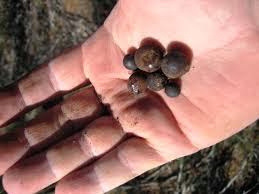
The resin in it's natural state looks like fire blackened brown pebbles. These can be gently washed in plain water to remove surface sand and char before being left to dry. When dry, use a mortar and pestle to grind the resin into a powder that can be as coarse or fine as you like. Use a mask because the resin is somewhat carcinogenic.


Using workable fixative in a glass jar, you can add the powdered resin to the fixative until you get the consistency and colour that you require. The excess powder will gather at the bottom but if left overnight in a sealed jar this will mostly be dissolved.

I also found that the solution can be mixed with molotow buff proof ink although I suggest being sparing as the ink is powerful and goes a long way. The balga resin itself is a blend of browns, yellows and reds and looks approximately like wood stain but without streaks. You will be left with a shellac like liquid that can be painted directly onto your surface. Allow to be completely dry before adding more layers.
I will add more pictures as my experimentation develops and hopefully be of help to you all!
I will add more pictures as my experimentation develops and hopefully be of help to you all!
update 23rd Oct 2013:
I really stress the importance of getting the resin as clean as possible before you start. I found that a lot of sand had been lurking in my block of resin! Also when it comes to brush cleaning, the resin can be cleaned off using more fixative, or you can do what I did and leave the brush to dry after wiping off excess; the resin will not clog the brush and will slough off when you flex the bristles.
I really stress the importance of getting the resin as clean as possible before you start. I found that a lot of sand had been lurking in my block of resin! Also when it comes to brush cleaning, the resin can be cleaned off using more fixative, or you can do what I did and leave the brush to dry after wiping off excess; the resin will not clog the brush and will slough off when you flex the bristles.
Tuesday, 15 October 2013
Matthew Ritchie: Chance and Skill
Matthew Ritchie is a very interesting polymath who came to the actual creation of art relatively late in life. This video is of a presentation he made at the University of Michigan and shows what drives, intrigues and informs Ritchie's work. I think anybody looking to see what the new black is or how to create a better ratrap should look at Ritchie, not for the easy answer but rather for how to look to what is being challenged, imagined and theorised right now in the world of high science and how that could inform high art.
Matthew Ritchie: Chance and Skill from UM Stamps School of Art & Design on Vimeo.
Wednesday, 9 October 2013
Death of... Matt Doust (and Perth is a Wonder of the World... almost)

After the death of Archibald prize finalist artist Matt Doust in LA last week* to an epileptic seizure, we are left with a void in the Perth art community. Doust was somewhat of a rockstar icon; a damaged and scruffy birdman with a surfeit of talent and almost totally unknown in Perth outside of other art aficionados. It makes me sad that a guy so young and well liked overseas is not being more venerated in the city that raised him. Venn Gallery is putting on a show in his honour this week and that is great but a bit more recognition while he was alive would've been good. I'm not talking about handshakes with the Lord Mayor Lisa Scaffidi, or a special show at Linton & Kay, I mean an interview on television, prime time, something that gets Doust and many other beautifully talented artists talked about by regular families. In a separate story, Perth has made it into the "Top 77 Cities" list according to Canadian-Swiss Bernard Weber, ahead of Melbourne, whose humble populace dubbed Perth as "Dullsville" a few years ago. Apparently this list is based on a net survey. Who knows, maybe the site that hosted it wasn't trendy enough for Melburnians.
The list is intended to be trimmed down to an eventual "7 Wonder Cities of the World"; the part that interests me, dear reader, is that next month the list will be trimmed dramatically to 28 cities. These will be cities like NY, London, Paris, Buenos Aires, Montreal, Beijing, etc. Ms Scaffidi, our aforementioned Lord Mayor, has asked Perth people to get in on it and vote "to help with tourism". Surely that isn't the point?
I would've thought the point was to get people in Perth thinking like they live in a wonder of the world. The same people who should be see seeing Doust and his ilk paraded on primetime television. It was the tourists who voted for Perth in the first place! Anyway, to climb on the bandwagon, you can vote here. Lets see if a city with only 1 major public funded art gallery can mix it with the big kids.
*Doust was only 29. What is it with this age that takes so many young talents away in the foreshadow of their best years? See Basquiat, Schiele, et al.
Tuesday, 8 October 2013
The role of art fairs in building a contemporary collection
"An artist at an art fair is like walking in on your parents having sex."
To have you work turned into a commodity is a difficult concept for many artists, but it is essential to the artist who wishes to make their living as a professional artist for their work to be valued and have a monetary value ascribed to it.
This is a grouping of a gallerist, a curator and a collector meeting in Washington, DC in the States and discussing the role of art fairs in building contemporary collections. After you have watched the video, please feel free to comment on whether or not you agree with them...
To have you work turned into a commodity is a difficult concept for many artists, but it is essential to the artist who wishes to make their living as a professional artist for their work to be valued and have a monetary value ascribed to it.
This is a grouping of a gallerist, a curator and a collector meeting in Washington, DC in the States and discussing the role of art fairs in building contemporary collections. After you have watched the video, please feel free to comment on whether or not you agree with them...
Wednesday, 2 October 2013
Thomas Doyle Sculpture Artist

Thomas Doyle's house sculptures are an intricate mix of hobby store modelling and bespoke cavernous pits and careful attention to detail that would shame a model train enthusiast. The figures in the works are modified, or 'converted' from store bought diorama fillers and have been subtly altered to change the feel of the piece. Doyle's own website is here and he has been Proteus Magazine's artist of the day here. What Doyle has created has been done before by sculptors such as William Christenberry, David Cole, and the amazing works of Takanori Aiba but what sets Doyle's apart, in my opinion, is his reserved approach. Details are subtle but well executed; flocked grass covers a face, almost as if by accident. These houses are not Aiba's colossi, or Christenberry's wooden mythologies, they are held back from that and to excellent effect. In Courier, the change of the ground angle by a small degree and the claustrophia of the trees pressing in on the house exagerates the lonlieness and unease of the solitary figure standing before the house. The figure may be approaching, or may be trying to get his balance. His one arm slightly outstretched looks almost as if he is reaching for a weapon; the human psyche playing tricks on him as it does on us and Doyle as a puppet master. If one were to be shrunk down and dropped inside one of these subtle hells, then one would be wishing for the end, unlike the seemingly oblivious occupants themselves. Doyle has taken a material, usually seen as something that modelling or wargaming enthusiasts would enjoy and made of them high art. There is something gratifying in that and I can recognise the dyed lichen and polystyrene and that makes it seem more approachable. This, however, is a trap of the mind. There is no way I could replicate this. I am too heavy handed, too beloved of colour and mythos. This belongs to a different sentimentality, one where less is more and then hung over the edge of a cliff. These works are beautiful and as far removed from toy trains as from a science lab. They are delicate, unworldly, timeless and stand on the backs of giants while heralding in another way of looking at art materials, inspiration and devastation. I would not want to live in Doyle's created world, but I do love these sculptures.
Thursday, 26 September 2013
Dealing with depression as an artist

I have suffered from depression for a very long time and when I started out as a professional fine artist some 13 years ago, I had no idea what it would feel like to part with a work or to take criticism or even how to cope with the dismissive glances that people would give my work. Cries of "my 3 year old could do that" and the like really hammered into me and I got in a pretty bad way after my first solo exhibition. However there is always an end to any blight of depression. As Winston Churchill said of his depression "It is a black dog which sits in the corner and looks at me".
Being an artist and dealing with negativity when artists are a pretty (very) emotional bunch is difficult at first. I'm not saying nor ever saying that you should stop feeling and sometimes the critique that you get from an uneducated blow in can cut to the quick of a matter or work better than any carefully regarded gallerist opinion.What I am saying is that if you are to feel every comment as a body blow then you will go down hill very quickly and be in a bad way like I was. We all know how artists can get.
What you need to do is basically buck up and get used to it. I can sell a work now and not get that lost limb ache. I can hear a negative comment and discard it after sifting it for useful information. I don't let it get to me because I am used to it. I got used to it and so can you.
The final important thing to remember is that you can always find someone to talk to. Get a different perspective on things and remeber that there is an equal amount of light and dark in life. Peace.
Subscribe to:
Posts (Atom)